Where is legitimacy? The political dispute over democracy on social media
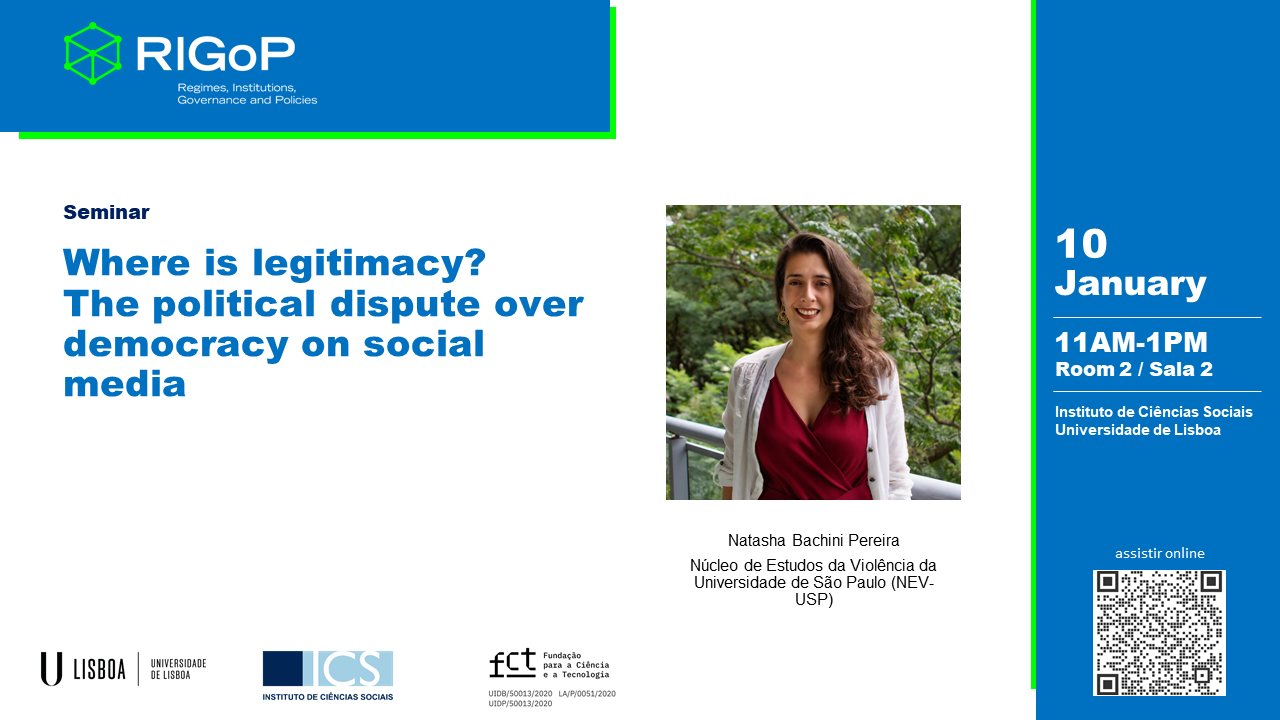
No dia 10 de janeiro, Natasha Bachini Pereira (Núcleo de Estudos da Violência da Universidade de São Paulo) será a oradora convidada do Seminário do Grupo de Investigação RIGoP sobre o tema Where is legitimacy? The political dispute over democracy on social media.
This seminar will present the findings of an article that analyzes the transposition of the discourse of the Brazilian right, which identifies itself as “conservative” to Facebook, as well as how this discourse is received by the followers of these pages. Engaging with authors who highlight historical resonances between the right, conservatism, and authoritarianism in Brazil, and building on research conducted by NEV-USP on this issue in the digital sphere, we investigate whether and how this social media platform has been used by actors in this field to contest democratic legitimacy.
To operationalize the research, we analyzed the framing of democratic institutions in the posts of actors whose publications received the highest volume of shares between January and June 2021. We then conducted semi-structured interviews with their followers. The analysis of these frames reveals the propagation of what I term "polymorphous inequalitarianism," which blends elements of neoconservatism and neoliberalism. Rather than being mutually exclusive, these frameworks converge into a reactionary identity that emphasizes distinctions between individuals. On one hand, the discourse asserts the moral superiority of these actors and their institutions, such as the patriarchal family, Christianity, and security forces. On the other hand, it endorses normative individualism and the corporate state (BROWN, 2006), thereby legitimizing violent state and private repression and exacerbating class, racial, and gender-based dominations that define Brazilian society.
Comparing the interviews, we find that the majority of followers align with these discourses, particularly regarding increased punitive measures by security forces. However, notable differences emerge concerning state involvement in the economy, the provision of public services, and support for the return of an authoritarian political regime.
A partir das 11h, na Sala 2 do ICS-ULisboa e online.