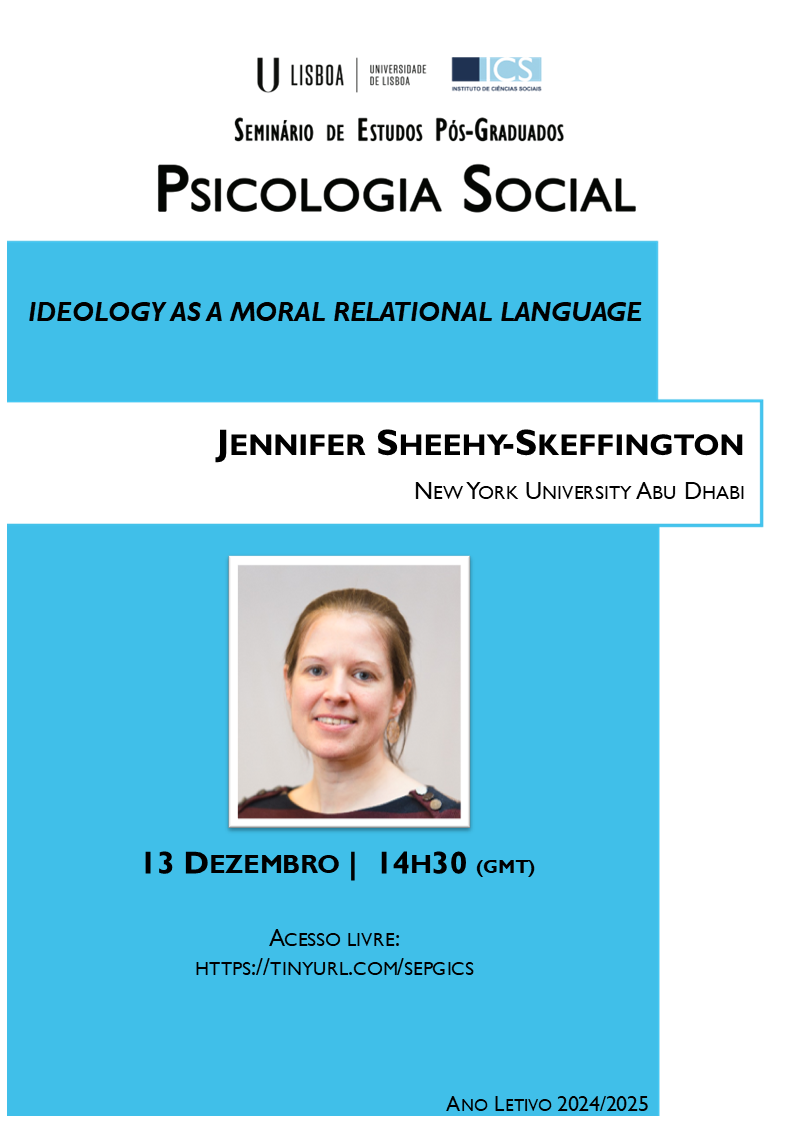
Seminário de Estudos Pós-Graduados: Ideology as a Moral Relational Language
Jennifer Sheehy-Skeffington (New York University Abu Dhabi) será a oradora convidada do próximo Seminário de Estudos Pós-Graduados em Psicologia Social, no dia 13 de dezembro. O tema para esta sessão será Ideology as a Moral Relational Language. A partir das 14h30, online.
A central dilemma facing societies of all scales concerns the distribution of power, assets, access, and rights. Such material and political arrangements and the relationships they engender are so fundamental to the challenge of human sociality that the psychology for navigating them has deep evolutionary, developmental, and cross-cultural roots. I will present a stream of research exploring the extent to which preferences toward the distribution of resources in society are grounded in universal representations and motives concerning basic social relationships, whose manifestation is dependent on socio-ecological context. On this account, what socioeconomic arrangements are seen as just, in addition to what political institutions are needed to enact them, depend on whether, when, and how one views politics through the lenses of hierarchy, equality, communality, parochialism, or proportionality. I will first review evidence from developmental and political psychology in support of this overall conceptual framework, before presenting findings from my research using nationally representative surveys, economic games, and genetically-informed analyses with the Norwegian Twin Registry.
Jennifer Sheehy-Skeffington is Associate Professor of Psychology at New York University Abu Dhabi and Associate Professor of Social Psychology at the London School of Economics and Political Science, where she is also a Faculty Affiliate of the LSE International Inequalities institute. She obtained her PhD in Psychology from Harvard University in 2014, where her dissertation was awarded Herrnstein Prize (2015).Jennifer’s research investigates the consequences of adversity and economic inequality on cognitive functioning, self-regulation, and perceived control, with downstream consequences for decisions in domains of health, education, and finance. She also studies the psychological foundations of political attitudes including egalitarianism and populist sentiment, and is more recently looking at how ideologies such as neoliberalism shape self-construals and social relations. Her work has been funded by the British Academy and the Joseph Rowntree Foundation, among others, and published in journals including Proceedings of the National Academy of Sciences and the Journal of Personality and Social Psychology. Jennifer is Associate Editor of the European Journal of Social Psychology and Guest Editor at Proceedings of the National Academy of Sciences and the Journal of Social Issues.