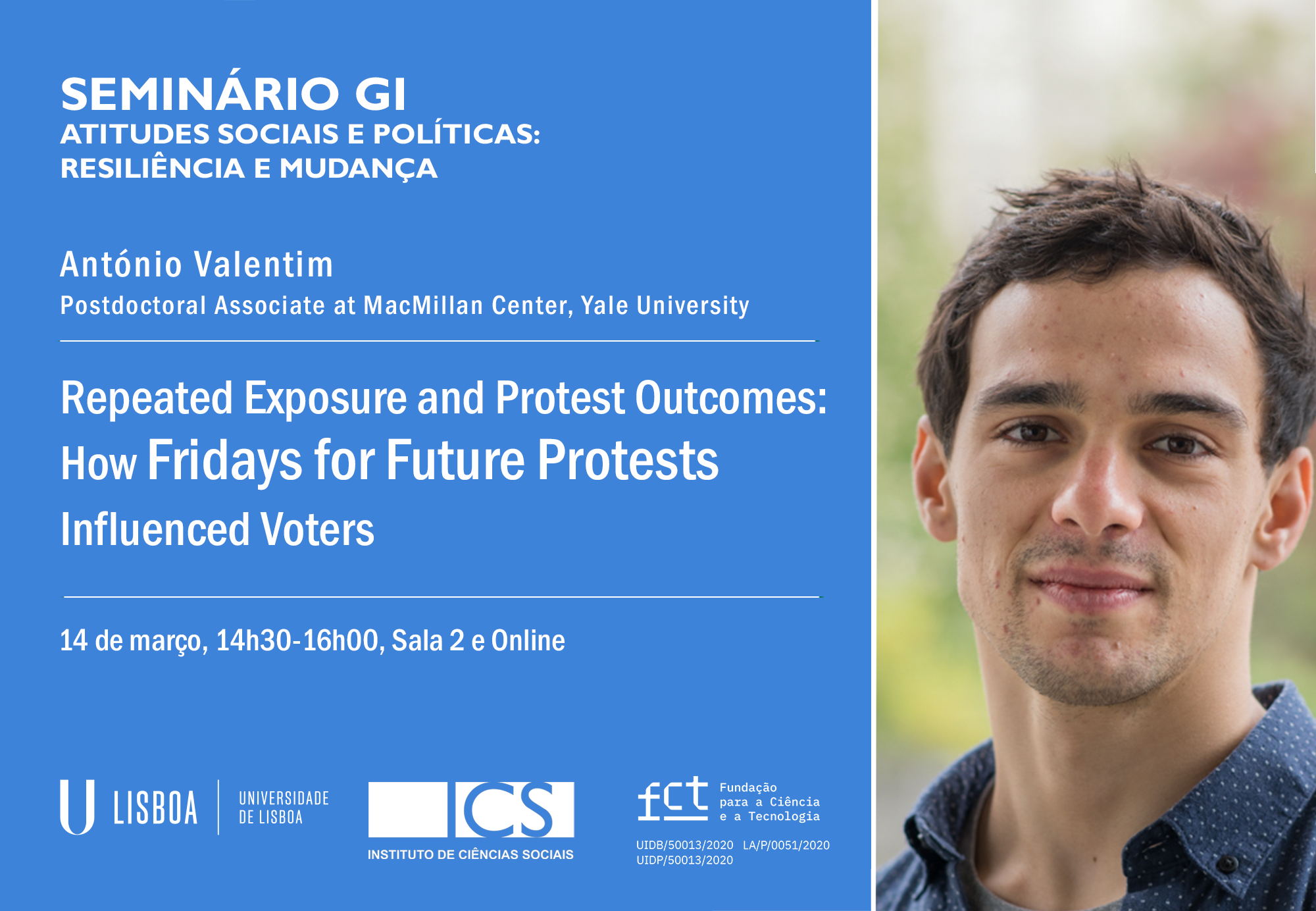
Repeated Exposure and Protest Outcomes: How Fridays for Future Protests Influenced Voters.
No dia 14 de março, o Seminário do Grupo de Investigação SPARC convida António Valentim, Assistente (MacMillan Center, Yale University) para debater o estudo Repeated Exposure and Protest Outcomes: How Fridays for Future Protests Influenced Voters.
O evento terá lugar entre as 14h30 e as 16h, na Sala 2 do ICS-Ulisboa e online, via Zoom.
Do climate protests have electoral consequences? When do political protests influence citizens’ behaviour? In this paper, I build on social-psychological work to argue that a key characteristic of effective protests is their capability to repeatedly expose voters to their message. I test this argument by studying the effect of Fridays for Future (FFF) protests on voting for Green Parties. Using a novel dataset on FFF protests in Germany, and a difference-in-differences design, I find that exposure to climate protests increases the vote share of the Greens, and that repeated exposure to protests increases this effect. Additional analyses suggest that repeated exposure persuades voters of FFF’s policy positions, and that these effects travel to other countries, but not to other environmental-friendly behaviours. Overall, these results are important to understand when and how protests are influential, as well as to understand the political consequences of climate protests.