Climate Change Response and the Reshaping of Urban Governance.
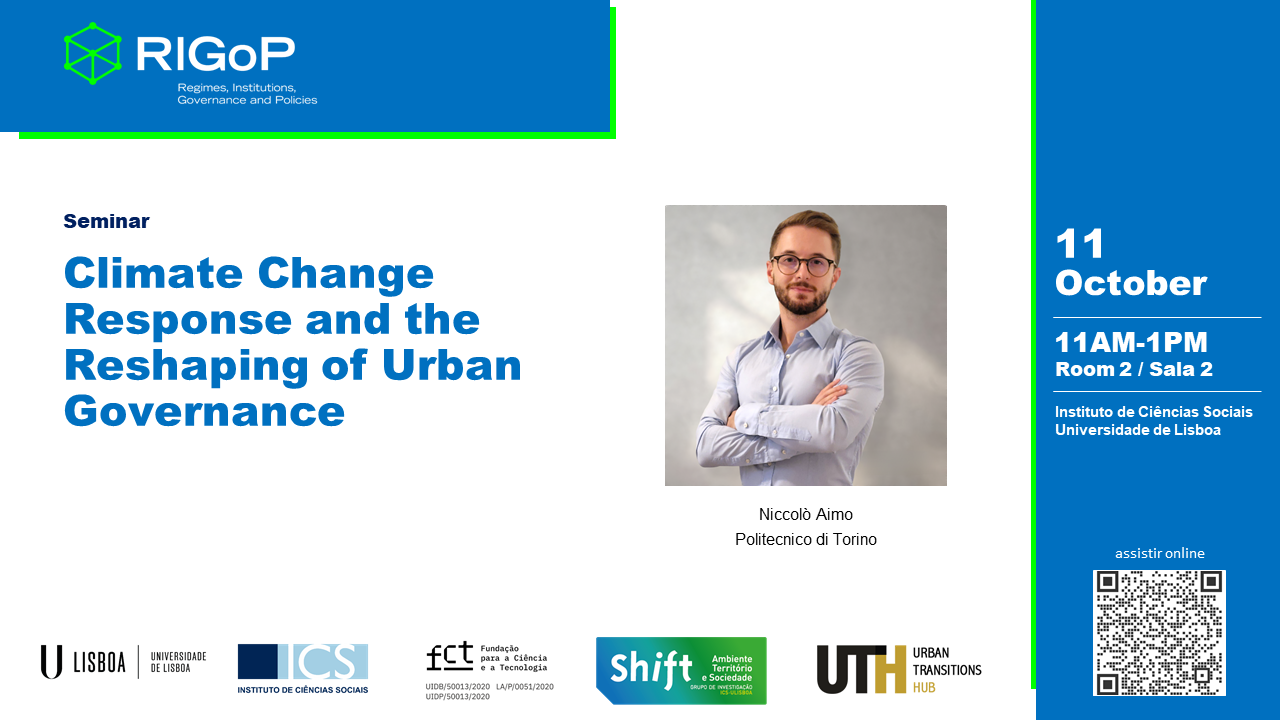
No dia 11 de outubro, Niccolò Aimo (Politecnico di Torino) será o orador convidado de um seminário conjunto dos Grupos de Investigação RIGoP e SHIFT. O tema para esta sessão será Climate Change Response and the Reshaping of Urban Governance. A partir das 11h, na Sala 2 do ICS-ULisboa e online.
In modern democracies, the local scale is a key space in which issues of global relevance are governed. In complex local governance arenas, actors are called to implement policies with contrasting goals, mixed instruments, and unstable coordination arrangements. Cities have grown in importance over the years as key players in many of the issues pressing governmental agendas, and especially the environmental one. Contemporary economic development has seen an unprecedented growth of cities, now hosting most of the global population. Together with their economies, also environmental impacts have grown. Following a vicious cycle, the more cities urbanize, the more climate change impacts on them. In relation to the environmental problem, research on public policy and administration has recently focused attention to the interplay between intersectoral issues, such as climate change, and administrative fragmentation. This strand of literature, generally known as the policy integration framework, has identified the mismatch between fragmented subsystems and inter-sectoral issues as a potential weakness contributing to the scarce success of climate change policymaking. Yet, the study of policy integration has largely focused on the national and international levels, largely overlooking subnational policymaking. This gap is especially relevant in contexts like the European Union, characterised by multilevel governance settings where different geographical scales interact with each other in constantly shifting geometries of power. The research, currently ongoing, analyses the local implementation of Next Generation EU, the main pillar of the European Green Deal strategy towards environmentally sustainable economies. Adopting the theoretical framework of policy integration, the research investigates the interplay between fragmentation and integration of policy goals, instruments, and actors in the cities of Genoa and Lisbon. The presentation will include some of the preliminary results of the Genoese case study.