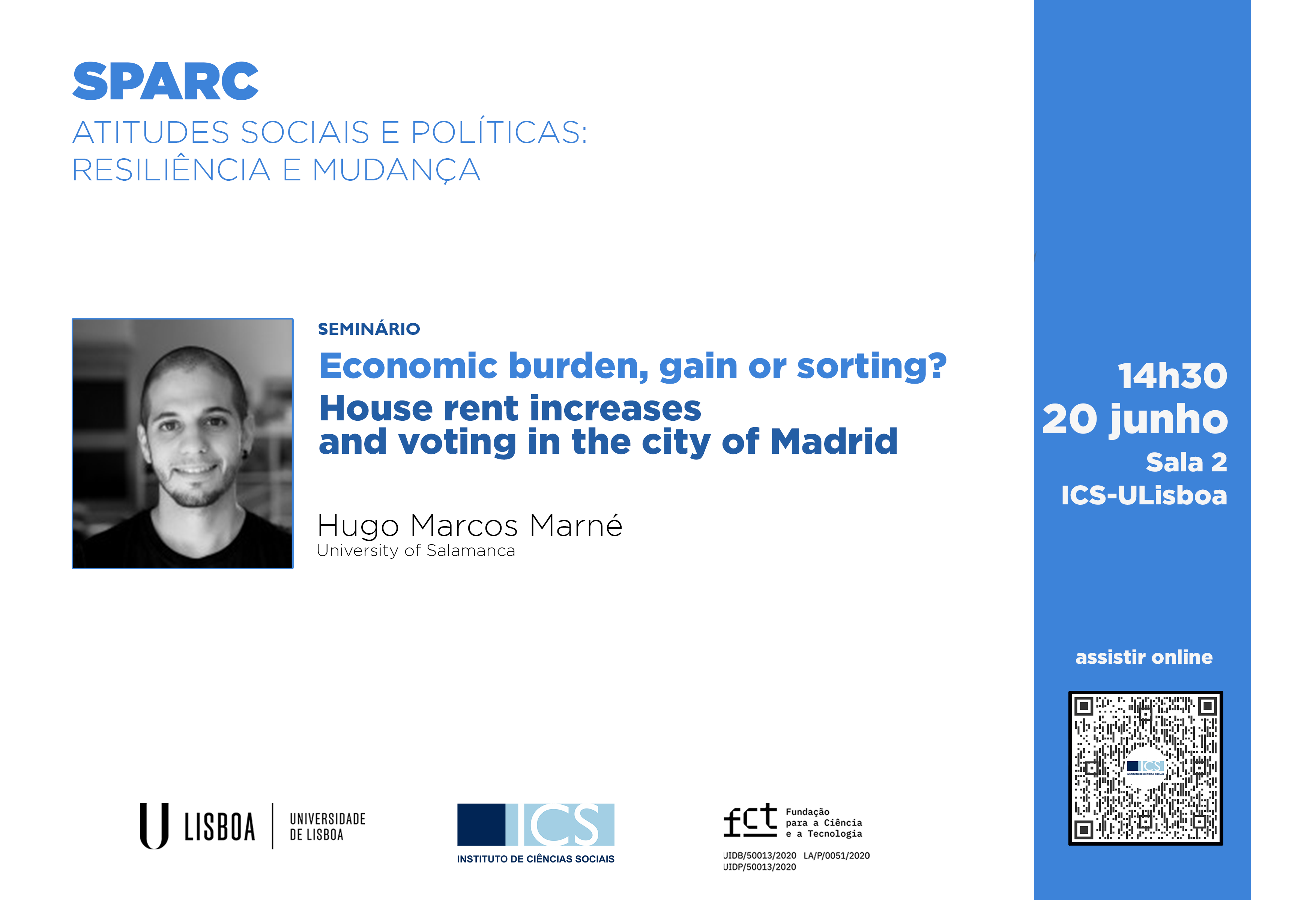
Economic burden, gain or sorting? Housing rent increases and voting in the city of Madrid
No dia 20 de junho, Hugo Marcos Marné (University of Salamanca) será o orador convidado do Seminário do Grupo de Investigação SPARC: Atitudes sociais e políticas: resiliência e mudança. O tema para esta sessão será Economic burden, gain or sorting? Housing rent increases and voting in the city of Madrid. Pelas 14h30, na Sala 2 do ICS-ULisboa e online.
The blooming literature on housing issues and voting has recently paid attention to the conditions under which populist parties may grow electorally. Evidence so far indicates that populists may benefit both from rising rents and declining prices, but the rationale behind these scenarios vary drastically depending at least on three key factors. First, the electoral platforms upon which populists compete, which can be differently oriented regarding the intervention of the state in the economy. Second, the house ownership structure, which interferes with how changing prices affect the population. And thirdly, the neighborhoods’ wealth. To delve into the granularity of these results we explore the association between house-rent variation and voting in the city of Madrid. Our main results indicate that rent increases only have a consistent effect on voting for the neoliberal and radical-right VOX, and the effect is particularly strong in wealthier districts. These results suggest that the association between variations in house-rents and voting in Madrid can be explained by an economic sorting scenario in which rent increases in wealthier districts benefit parties who oppose the intervention of the state in the economy.