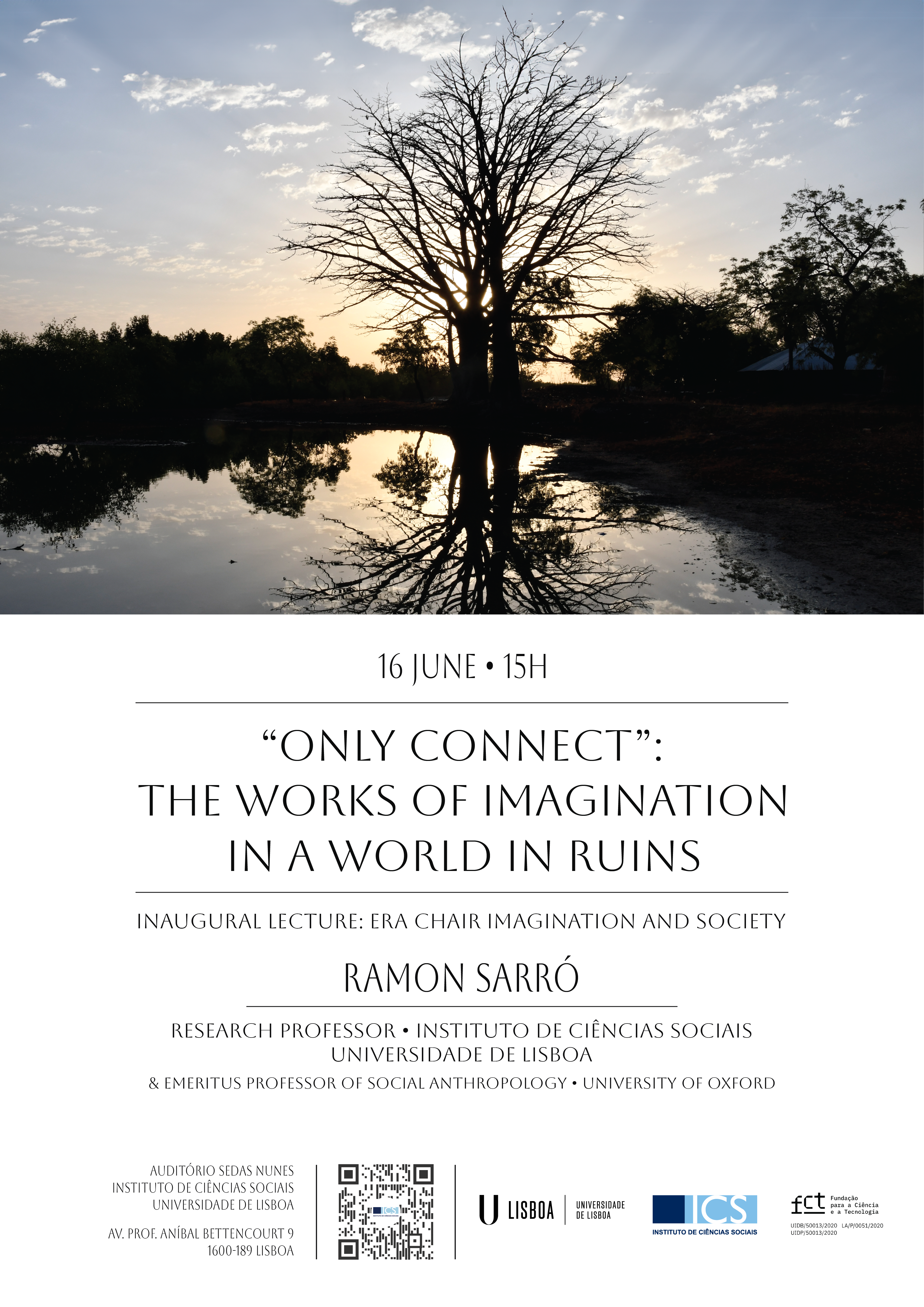
“Only connect”: The works of imagination in a world in ruins
The Inaugural Lecture of the Imagination and Society Chair will take place at ICS-ULisboa n June 16th. Ramon Sarró, Visiting Principal Researcher at ICS-ULisboa and Professor Emeritus in Social Anthropology at the University of Oxford will present the lecture "Only Connect": The Works of Imagination in a World in Ruins. The event starts at 3pm, at the Auditório Sedas Nunes, ICS-ULisboa.
This keynote address will explore the multifaceted nature of imagination, emphasizing two main aspects. First, its poetic potential in the making of “as if” alternative scenarios in our minds, spaces of imagination where we can find some freedom when reality goes awry. Second, its role in connecting the seemingly unconnected—sensory and intelligible, inner and outer, present and absent, possible and impossible, past and present, far away and close by. Imagination offers a solid platform for the interdisciplinary analysis of various aspects of society—history, migration, environment, nationalism, and more—highlighting its importance in shaping, sometimes destroying, and often repairing human worlds.
Historically, imagination has been viewed with ambivalence, as both a creative power and a potential obstacle to positive, realistic thinking and progress. Popular culture captures this ambivalence, from Joseph Conrad’s cautionary depiction to John Lennon’s idealistic song “Imagine”. Yet, imagination has significantly influenced the formation of nations, borders, identities, and conflicts, underscoring both its power to assemble and its destructive potential.
Without denying the inherent ambivalence and ethical contradictions of imagination, we see it as essential to human existence and understanding. Imagination shapes our perception of space and time—how we organize places, histories, memories, futures. Viewing imagination through the lenses of today’s several crises highlight its role in reconnecting fractured worlds and in defining what it means to be human. In an “era of anxiety”, to borrow Auden’s poetic concept, and of rapid technological advancement, understanding and developing imagination might well be crucial in helping us avoid an irreversible loss of control over our collective futures.